A neural journey into disease transmission models
Let’s start with an elementary, but yet insightful equation system commonly known as the SIS disease transmission model. Full stop. Let’s start from somewhere else.
Phenomenology of infectious diseases
The fact that biological entitities such as viruses, bacteria and fungi have durably colonized the human body sets the stage for a life-long antagonistic relationship between them and us - the parasites and the hosts. But not only this unfriendly relationship sets them apart from each other, these best enemies live on distinct spatial and temporal scales. Viruses are sized in the micrometers and can only be observed via electronic microscopy, and one virus can produce offspring in the tens of thousands within hours or days. On the other hand, multicellular tissue heaps known as humans are sized in meters, and it takes decades for them to reproduce, if at all. The action starts when parasites enter human cells, mainly by tricking their surface proteins and making it into the cellular reproduction machinery. Parasites exploit the host cell for their own metabolism or reproduction. Eventually the host cell will disintegrate, parasite offspring is released into the cellular environment to find its next victim. But one host is not enough. Insatiable as they are, the parasites need to transmit in order to continue living, as their fate is bound to the host. In order to enter into new hosts, parasites undergo continuous selection, their genetic makeup changes randomly as they replicate. Full stop.
For microbiologists, this description of a parasite’s lifecycle might sound like an overly simplified vulgarisation, yet it is a physicist’s nightmare: biochemical entities interacting at multiple scales. From the medical perspective, we are dealing with discrete, host-centric events: life, death, infection, symptoms, recovery. This is where disease transmission models start from. Disregarding the complexities of biochemical interactions that allow the parasites to enter host cells and ignoring the evolutionary ecology of parasite population dynamics, they assign each host to a compartment. Like in the old days, when train coachs were divided into compartments, one could comfortably talk, eat and smoke (sic!) in the compartment, granted that all individuals in the compartment would be alike. In the same way, all hosts that share attributes such as susceptible (to infection), infectious (to other hosts) or recovered (from infection) are put into their respective compartment. A rather ad-hoc set of rules defines how hosts can change between compartments, e.g. an infectious host might recover after some time, in the same way as people move from the non-smoking to the smoking compartment on the train. Disease transmission models track the size of the compartments over time. Differential equation techniques of the ordinary, stochastic, delay or partial kind have been invoked to produce model solution curves to be aligned with epidemiological observations.
Infection disease dynamics
Let’s start again with an elementary system of differential equations, which models the temporal evaluation of only two compartments, susceptible (S) and infectious hosts (I). Let’s denote the total population size with \(N=S+I\) and assume that \(N\) remains constant. We posit two ad-hoc rules of transitioning between compartments.
First, for each susceptible host, the probability of finding an infectious host in the population is \(\tfrac{I}{N}\), and since there are \(S\) susceptible hosts, we would have on average \(\beta S \tfrac{I}{N}\) susceptible hosts moving to the (I) compartment. The parameter \(\beta>0\) encapsulates all the biochemical and eco-evolutionary complexities that we proudly ignored.
Second, infectious hosts might also recover from infection and move to the susceptible compartment with rate \(\gamma\), and we would end up with \(\gamma I\) hosts on overage moving from the (I) compartment to the (S) compartment.
Differential equations
Differential equations bear their name from the physical principle of motion. In order to describe the trajectory of an object, we only need to know its initial position and its velocity. From the point of view of measurement, velocity should be seen as change of position between two consecutive time points. Mathematicians would paraphrase this measurement of change as difference quotient, and as the distance between consecutive time points gets very small, they would refer to the change as differential quotient or short differential. In its simplest form, this differential depends only on the position itself. So, differential equation, here you are! On your left-hand side, we put the differential to measure infinitesimal change in position, on your right-hand side we put some function of position and other things to quantify the strength of change. Mathematicians are fond of definitions, and even have a name for your right-hand side: they call it a vector field.
Our SIS system reads:
\[\begin{aligned} \label{eq:sis} \frac{dS}{dt} &= -\beta S \tfrac{I}{N} + \gamma I \\ \frac{dI}{dt} &= \beta S \tfrac{I}{N} - \gamma I \end{aligned}\]Under the assumptions of constant population size we set \(S=N-I\) and the SIS system simplifies to a single equation: \begin{equation} \label{eq:sis_simple} \frac{dI}{dt} = \beta (N-I) \tfrac{I}{N} - \gamma I = (\beta - \gamma)I- \tfrac{\beta}{N}I^2 \end{equation}
Our differential is \(\frac{dI}{dt}\) and the vector field reads \(f(x)=(\beta - \gamma) x - \tfrac{\beta}{N}x^2\). The linear part \(x\mapsto (\beta - \gamma)x\) of the vector field describes how the balance between new infections and recovery relates to the growth of (I), especially in the beginning. If \(\beta - \gamma<0\), negative growth will push eventually the system to the state \(I=0\), the so-called disease-free equilibrium. If \(\beta - \gamma>0\), the non-linear part \(x\mapsto -\tfrac{\beta}{N}x^2\) of the vector field helps to keep the system in place: there cannot be more than \(N\) hosts! If \(I\) is close to \(N\), the \(\beta / N\) terms cancel out and \(x\mapsto -\gamma x\) will push the sytem to lower values of \(I\), it will eventually reach \(I=N\tfrac{\beta - \gamma}{\beta}=N\left(1-\tfrac{\gamma}{\beta}\right)\), the so-called endemic equilibrium.
One picture is worth a thousand words goes the saying. In the figure below on the left panel you can inspect the solution curve to the SIS system for parameters set to $\beta =0.5$, $\gamma=0.1$ and $N=100$. 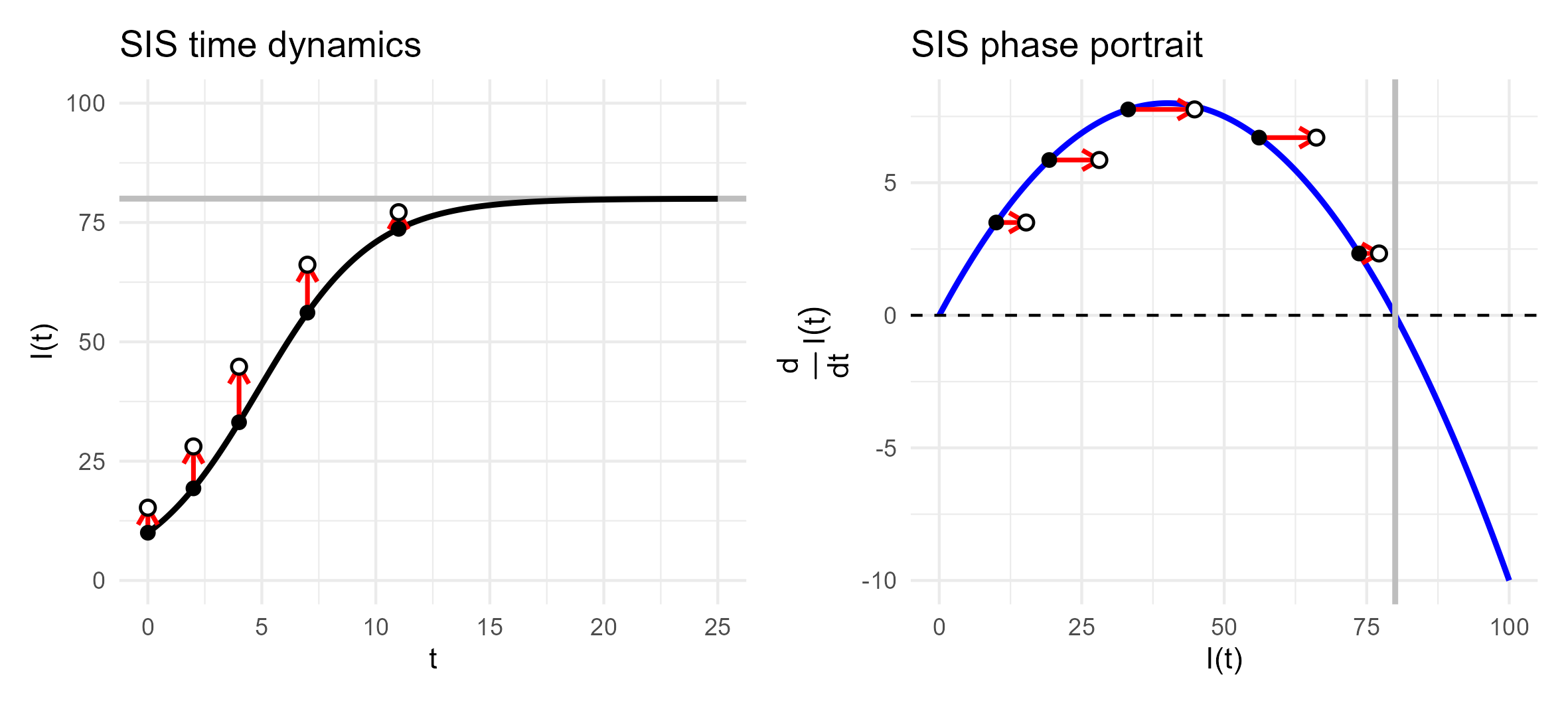
Try to follow the curve from the initial condition at time $t=0$! The red arrows indicate the strength of the vector field $f$, i.e. how much more infections we would expect at the following time point. As we reach the endemic equilibrium, the arrows become shorter and shorter. As the number of infected individuals becomes large, the depletion of susceptibles will make difficult to create new infections. The panel on the right-hand side is called a phase diagram. We remove the time axis, and plot the number of infected individuals against its time derivative. According to our SIS system, this time derivative equals the vector field evaluated at the state of the system:
\[\frac{d}{dt}I(t) = f(I(t))\]From the phase diagram we can clearly witness what the depletion of susceptibles means to the vector field. As we approach the grey line, the red arrows become smaller and smaller and would eventually go to zero. Had we started our SIS system at a very high number of infected individuals, e.g. $I(0)=95$, then the vector field evaluated at $I(0)$ would have negative values, since the blue curve is below zero in this case. Again, the SIS system would have eventually reached its endemic equilibrium.
Numerics of differential equations and inference
To solve the differential equation $\frac{dI}{dt} = f(I)$ we evaluate the vector field at discrete, equidistant time points $t_i=t_0+i\Delta$:
$\begin{equation} \label{eq:sis_simple_num} \frac{I(t_{i+1})-I(t_i)}{\Delta} = f(I(t_i)) \end{equation}$ and rewrite the equation as a recurrence relationship $I(t_{i+1})=I(t_i)+\Delta f(I(t_i))$. If you know the initial condition $I(t_0)$, then you can calculate $I(t_1)=I(t_0)+\Delta f(I(t_0))$ and so forth for $I(t_2))$ etc. This recurrence relationship is also known as (forward) Euler method. It is the first among many numerical methods to solve differential equations. In our concise style of writing down the recurrence relationship we have omitted that the vector field $f$ depends on real-valued parameters $\beta, \gamma>0$ and the population size $N$. Let us assume that we know $N$ and that we have observatios $\iota(t_i)$ of the number of infected individuals at time points $t_i$. Let us align observations and model outputs and compare them with some sort of metric ${\cal L}$. One could choose for instance the sum of squares as loss function:
\[{\cal L}(\beta,\gamma)=\sum_i (\iota(t_i)-I(t_i))^2\]The task of parameter inference is to find $\beta, \gamma >0$ such that ${\cal L}$ is minimal. Sounds straight-forward? In principle it is, but if observed disease data is sparse and we don’t know how possible external factors like climate or mobility influence the number of infectious individuals in our model, we could end up with a perfectly minimized loss for a meaningless model that would not stand the test of validation. To include externalities, the obvious straws to clutch at would be to replace the parameter $\beta$ by a time-dependent function
\[t\mapsto \beta(t)\equiv\beta(t,\theta_1,\theta_2)=\theta_1\left( 1+ \sin \tfrac{2\pi t}{\theta_2}\right)\]which could for instance represent seasonality patterns of new infections. There is of course a price to pay when we increase model complexity. In this example we have to infer two parameters $\theta_1, \theta_2>0$ instead of one.
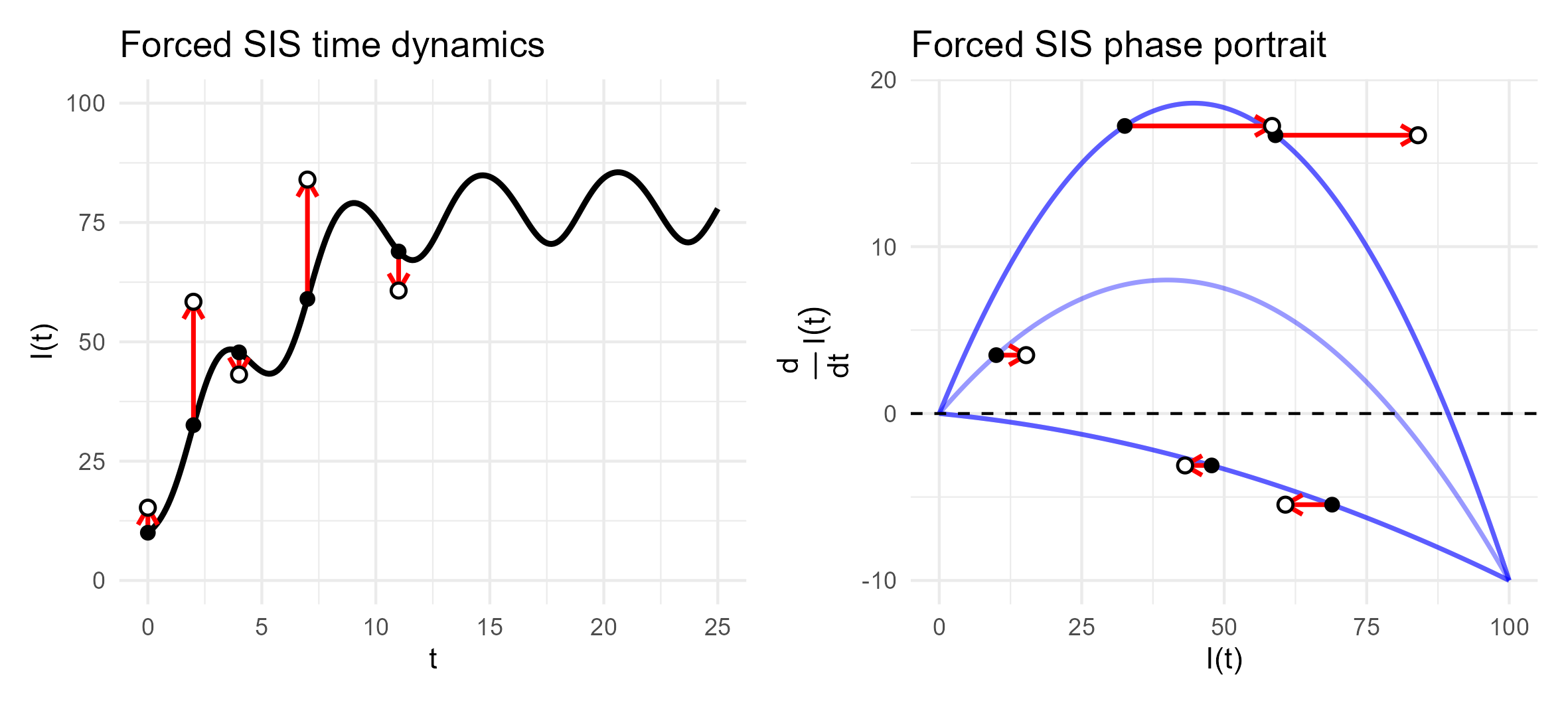
We plot again the phase diagram for an ODE with time-dependent, periodic coefficients. Depending on the position of the epidemic, the vector field changes sign resulting in a endemic equilibrium which is no longer a point but aperiodic function.
In the old days, seasoned modelers would warn you to increase the number of parameters, and the Akaike information criterion would guide modelers, as it quantifies the trade-off between minimizing the loss while limiting the number of parameters to infer. But these times have revolved. In the days when computing clusters are filled up with graphic processing units that allow to perform fast computations on large amounts of features (such as seasonality), the inference task is less heroic. We still aim to minimize the loss, but now we allow millions of parameters (called neural network weights) to vary.
Residual neural networks
In machine learning, algorithms such as the Euler method have been utilized under the name of residual neural networks. Again, we have “information blocks” $I$ (e.g. vectors or tensors of real numbers) that are indexed with $k, k+1,\dots$. In order to move from block $k$ to block $k+1$, a neural network element $\mathfrak{f}$ (e.g. a vector-valued function) is used. Here, $\mathfrak{f}$ could be any continuous mapping that takes a vector of size $n$ into a vector of size $m$. Often, neural network elements use elementary functions such as step functions or sigmoids and combine them by algebraic operations. We had an explicit form for $\mathfrak{f}$. Seen as a neural network element, it takes a real number and produces another real number, with some fixed weights $w=(w_1, w_2, w_3)$:
\[\mathfrak{f}_w: x \mapsto w_1 x \oplus w_2 x \oplus (w_3 x\otimes x)\]This neural network element \(\mathfrak{f}\) should look very familiar. If we set $w_1=\beta, w_2=-\gamma, w_3=-\tfrac{\beta}{N}$, it is exactly our vector field \(f(x)=(\beta - \gamma) x - \tfrac{\beta}{N}x^2\). The operators $\otimes$ resp. $\oplus$ are called tensor product resp. direct sum.
Thus formally, residual neural networks translate the idea of Euler to neural networks:
\[I(t_{i+1})=I(t_i) \oplus \mathfrak{f}(I(t_i))\]In order to move to the next block, you simple take the value of your current block and update it in the direction of the neural network element \(\mathfrak{f}\).
Where vector fields live
Let’s have another look at the phase diagram on the left of our figure. We have seen that with numerical integration, we can transform a vector field into a solution curve, given any initial condition. The phase diagram shows how the solution curve is shadowed by the vector field, as if a magic, invisible hand was guiding us through the unknown territory of the state spaces. Here, state space designates the space where our dynamical system can have its solution. In our case we know that $0\leq I(t) \leq N$, so our state space is ${I(t); 0\leq t\leq T}=I([0,T])\subset [0,N]$.
Let’s assume our dynamical system is currently located at $I(t)$, then the tangent to this particular state is $\tfrac{dI}{dt}(I(t))=f(I(t))$. This tangent is a vector, it has a direction and a length, determined by the coefficients of our vector field $f$. In our case the tangent is a straight line embedded in the plane. If we now collect from time $t=0$ to some time $t=T>0$ all our states and tangents, we obtain a tangent bundle:
\[TM=\bigcup_{t\in [0,T]} T_{I(t)}M=\bigcup_{t\in [0,T]} (I_t,f(I(t))\]Again, in our simple case \(TM=f(I)\), which is the graph of our solution curve $I$ under the real-valued function $f$. Think of the tangent bundle as a cord with straws attached.
Tangent bundles are mathematical objects of their own wright. Each fiber $T_xM$ for $x=I(t)$ is a vector space, where we can perform the usual operations such as addition, scalar product, scalar multiplication or rotations.
Inference problem
We have invistigated our differential equation with vector field and neural network glasses. But there is yet another way of looking at it. We can also integrate the differential equation. By definition of the integral, we obtain $I(t_{i+1})-I(t_i)= \int_{t_i}^{t_{i+1}} f(I(t)) dt$ and for small $\Delta>0$ we can assume $\int_{t_i}^{t_{i+1}} f(I(t)) dt\sim \Delta f(I(t_i)) $. We solve our differential equation by literally integrating along the vector field $f$. For this reason $t\mapsto I(t)$ is also called an integral curve. By definition, the vector field is tangent to the integral curve. If we know the tangent directions and strength for every state of our system, we can construct integral curves. If we now integral curves from every possible initial condition, we can construct vector fields.
With our expert knowledge about disease transmission we were highly confident about the structure of the vector field $f$. Let’s come back to the rather opaque parameter \(\beta>0\). We admitted that we packed all the biochemical and eco-evolutionary complexities that modulate the infectiousness of the parasite into this parameter. Let’s put in some effort and make it at least time-dependent. To keep things simple, let us assume that \(t\mapsto \beta(t)\) is non-negative and periodic with fixed amplitude \(\theta_1>0\) and period \(\theta_2>0\): $\begin{equation} \beta\equiv\beta(t)\equiv\beta(t,\theta_1,\theta_2)=\theta_1\left( 1+ \sin \tfrac{2\pi t}{\theta_2}\right) \end{equation}$ Periodicity of $\beta$ makes sense for a parasite such as seasonal influenza virus from the point of view of its biochemistry. It is in dry and cold climate during winter that the protecting lipid layer becomes solid-like, the virus persists in the environment. The surface protein so important for cell entry is conserved in its polymer structure, the virus remains infectious. Not to speak of hosts crowding in trains and classrooms during cold season. Letting $\beta$ depend on time and including the amplitude and period parameters \(\theta=(\theta_1,\theta_2)\) requires some updates to the vector field $f$ of our differential equation. In its simplest form, $f$ depends only on the position $x$, but in our cases, the vector field depends also on time $t$ and \(\theta\): $\begin{equation}f_{\theta,t}(x)=(\beta(t,\theta_1,\theta_2) - \gamma) x - \tfrac{\beta(t,\theta_1,\theta_2)}{N}x^2\end{equation}$
Our differential equation know reads $\frac{dI}{dt} = f(I)$
Packing all this complexity into a sine function seems like a leap of faith bound to fail. And what is the purpose of all of this? Let’s put our model to the test of observations.
Coming back from a lengthy field trip to a remote island, your epidemiologist neighbour carries a dataset full of observations in his backpack. After some data cleaning, he gives you the number of infectious hosts recorded at \(K\) distinct time points: \(\iota(t_1),\dots,\iota(t_K)\). From his anectotal notebook about the disease you calculate the recovery rate \(\gamma\). So far, so good. In order to compare data to model outputs, we need to quantifiy how far these model outputs are away from the data by an error function: \(\begin{equation} {\cal J} = \frac{1}{K}\sum_{j=1}^{K} g(I(t_j), \iota(t_j)) \end{equation}\) To make things easier, we use \(g(x,y)=\tfrac{1}{2}|x-y|^2\) and \(J\) is called the residual sum of squares. But there is yet another way to look at ${\cal J}$. It is a functional. A functional is like a function, only that it is defined on a larger, often infinite-dimensional space such as the space of all possible solution curves to our SIS model. Remember, we keep initial conditions and \(\gamma\) fixed since we trust our epidemiologist neighbour, and the only other parameter \(\beta\) is written in a form where it depends on amplitude and period \(\theta=(\theta_1,\theta_2)\). Thus, a particular choice for \(\theta\) yields a unique solution curve \(\{I_{\theta}(t);t\geq 0\}\). The functional \({\cal J}\) maps the solution curve to a real number, the error between the model and observations.
The task of parameter inference is to find values for \((\theta_1,\theta_2)\) such that this number \({\cal J}[\{I_{\theta}(t);t\geq 0\}]\) is minimal. When minimizing functionals over a spaces of curves, we enter the calculus of variation, a mathematical field dating back to Euler and which has been properly formalized only in the last century under the name of functional analysis. Parameter inference emerged from statistics and should be considered rather a cognitive task with different computational approaches such as hypothesis testing, maximum likelihood and Bayesian updating. Whether parameter inference should actually be considered an optimization problem will spur important philosophical discussions. What is reality? The data that your epidemiologist neighbour brought back from his trip? The biochemical laws underlying disease transmission which our models seeks to mimick to the point of a caricature?
Let’s go back to the error function:
\[\begin{equation} {\cal J} = \frac{1}{K}\sum_{j=1}^{K} g(I(t_j), \iota(t_j)) \end{equation}\]If we had infinitesimal time increments of observations, we can write ${\cal J}$ as an integral:
\[\begin{equation} {\cal J} = \int_{t_1}^{t_K} g(I(t), \iota(t))dt \end{equation}\]So far, so good. There is actually a way in which the model can observe itself. Let’s revert back to our elementary model $\ref{eq:sis_simple}$, but with the addition of a control function $t\mapsto u(t)$:
$\begin{equation} \frac{dI_u}{dt} = (u(t)\beta - \gamma)I_u- \tfrac{u(t)\beta}{N}I_u^2 \end{equation}$
You can think of $u$ as a way to stir the dynamical system into a certain state. E.g. we could look for a function that will minimize the number of infections during a defined time horizon \(\begin{equation} {\cal J} = \int_{t_1}^{t_K} I_u(t) dt \end{equation}\) Instead of minimizing over \(\theta\), we would now minimize over the space of admissible control functions.
Lagrangian multiplier Hamiltonian, adjoint; Lagrangian with time-dependent multiplier Pontryagin
\[H(I, \lambda, \beta, \gamma) = L(I, t) + \lambda(t) \left[ (\beta - \gamma)I - \frac{\beta}{N}I^2 \right]\]\begin{equation} \label{eq:cauchy-schwarz} \left( \sum_{k=1}^n a_k b_k \right)^2 \leq \left( \sum_{k=1}^n a_k^2 \right) \left( \sum_{k=1}^n b_k^2 \right) \end{equation}
and by adding \label{...} inside the equation environment, we can now refer to the equation using \eqref.
Note that MathJax 3 is a major re-write of MathJax that brought a significant improvement to the loading and rendering speed, which is now on par with KaTeX.